
Why is walking in the dark so hard with neuropathy?
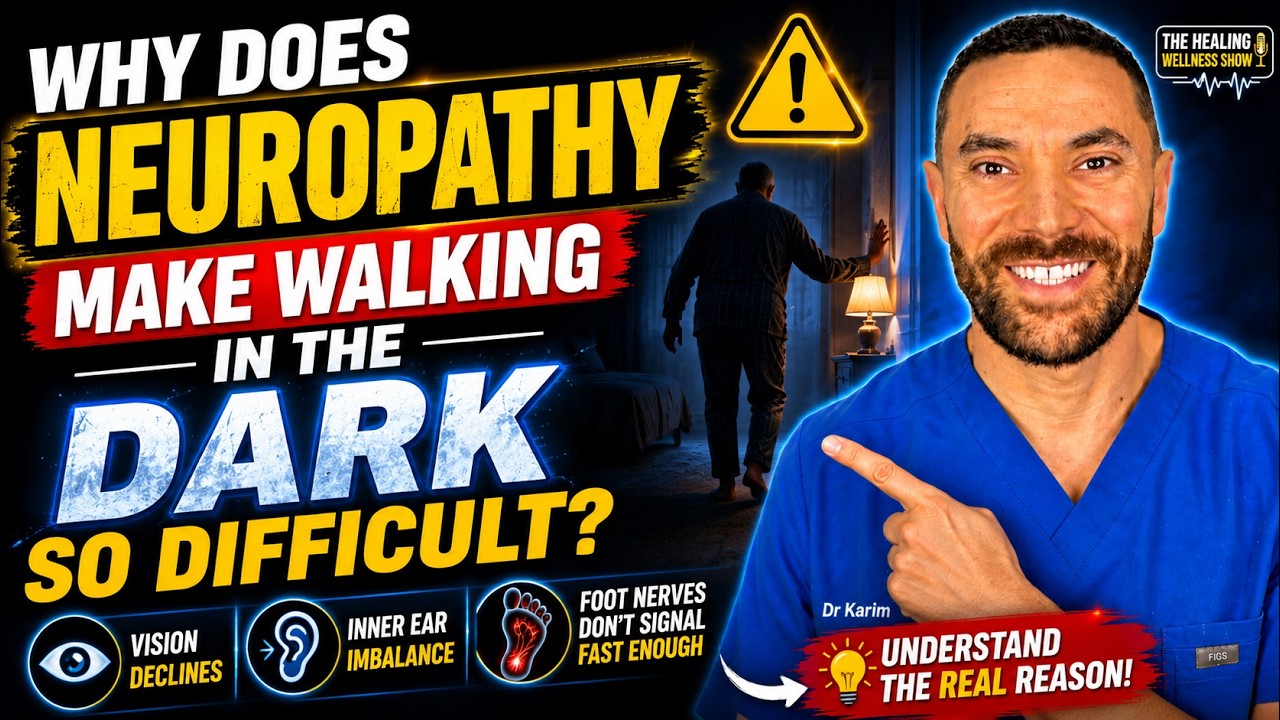
Short answer: walking in the dark is harder with neuropathy because your eyes have been quietly doing your feet’s job. Balance depends on three systems: vision, the inner ear, and the nerves in the soles of your feet. When those foot nerves slow down, the brain leans on vision instead. Turn the lights off and the backup is gone, which is why so many people grab for walls on the way to the bathroom at night but walk fine at noon.
Three balance systems, and the one that usually fails
Dr. Mohamed Karim, D.C., walks through all three in this episode. Vision tells you where you are in the room. The inner ear handles motion and position, which is why a bout of vertigo can put someone on the floor. And the nerves on the bottom of your feet report every tilt and uneven step to the brain, which fires back a correction.
In his experience the inner ear is behind a very small share of balance problems in people with neuropathy. It is usually the feet.
Healthy nerve fibers carry signals fast, around 270 miles an hour for the quickest ones. When damage or poor circulation slows them, the message “you are tipping left” reaches the brain too late for it to shift your weight right. So people start watching their feet on the stairs without noticing they have started. They are fine as long as they are looking.
Why it gets worse at the end of the day
Leaning on your eyes all day is tiring. By evening, the brain has been compensating for hours and concentration slips, so balance feels shakier even before the sun goes down. Then comes the dark hallway at 2 a.m., when you are half asleep and your eyes have nothing to work with.
That is also why nighttime is such a revealing test. If you are steady in daylight and unsteady in the dark, the problem is very likely the signal from your feet, not your age.
Why a fall at night is the real danger
Dr. Karim is blunt about the stakes. People fall in the night, break a hip or a leg, cannot move and cannot reach a phone. Some are not found for hours. The CDC reports that more than one in four adults over 65 falls each year and fewer than half tell their doctor, and roughly 319,000 older adults are hospitalized for hip fractures annually.
Small stumbles count too. Catching yourself on the counter is information, not a lucky save.
What to change tonight
- Night lights everywhere you walk after dark: bedroom, hallway, bathroom, kitchen. Motion-sensor lights are even better.
- Clear the path. Rugs, cords, shoes and a nightstand corner you know by heart in daylight are all trip hazards at 2 a.m.
- Sit on the edge of the bed first. Let your eyes adjust to the light, check your balance, then stand, then walk. Do not rush.
- Wear supportive footwear around the house instead of socks on hard floors.
For shoes, Dr. Karim usually sends people to a podiatrist for a foot scan, since custom orthotics or shoes give the most support. Wider shoes help people whose symptoms flare with pressure, and Velcro closures help when neuropathy has reached the hands and tying laces has become fiddly.
Rhonda’s evenings
Rhonda, who has let the clinic share her story, was a widow living alone. Days were fine. Evenings in her recliner were not: numbness, tingling, cramping, throbbing, burning. When she got up at night she needed a cane or a walker.
Dr. Karim’s explanation for the evening flare is the same brain-and-nerve connection. When you are busy, the brain is occupied. When you sit still at night, it has room to notice everything that hurts.
What finally brought her in was fear. She had fallen a few times, and a friend of hers had recently fallen, broken a hip and ended up in a wheelchair. Rhonda loved to garden. When the clinic tested her, she had about 85% nerve loss in her feet, leaving roughly 15% to tell her brain where the ground was.
Watch the full episode
Three takeaways
- Balance relies heavily on feedback from the nerves in your feet.
- Your eyes cover for weak nerves during the day, which hides the problem.
- Darkness exposes it. Do not ignore it.
Steady by day and unsteady at night? That is worth a test. Read how neuropathy treatment in North Liberty starts, or book a free consultation. Related: why night driving gets harder with neuropathy.
This article summarizes a podcast episode and is general information, not medical advice. If you have fallen and hit your head or cannot bear weight, get emergency care. Fall statistics: CDC, Facts About Older Adult Falls. See our medical disclaimer.
Free consultation
Talk to Dr. Karim about your symptoms
Iowa Wellness Center, 1395 Jordan St Unit C, North Liberty, IA. Patients come in from Iowa City, Coralville and Cedar Rapids.