
When should someone with neuropathy stop driving? The warning signs
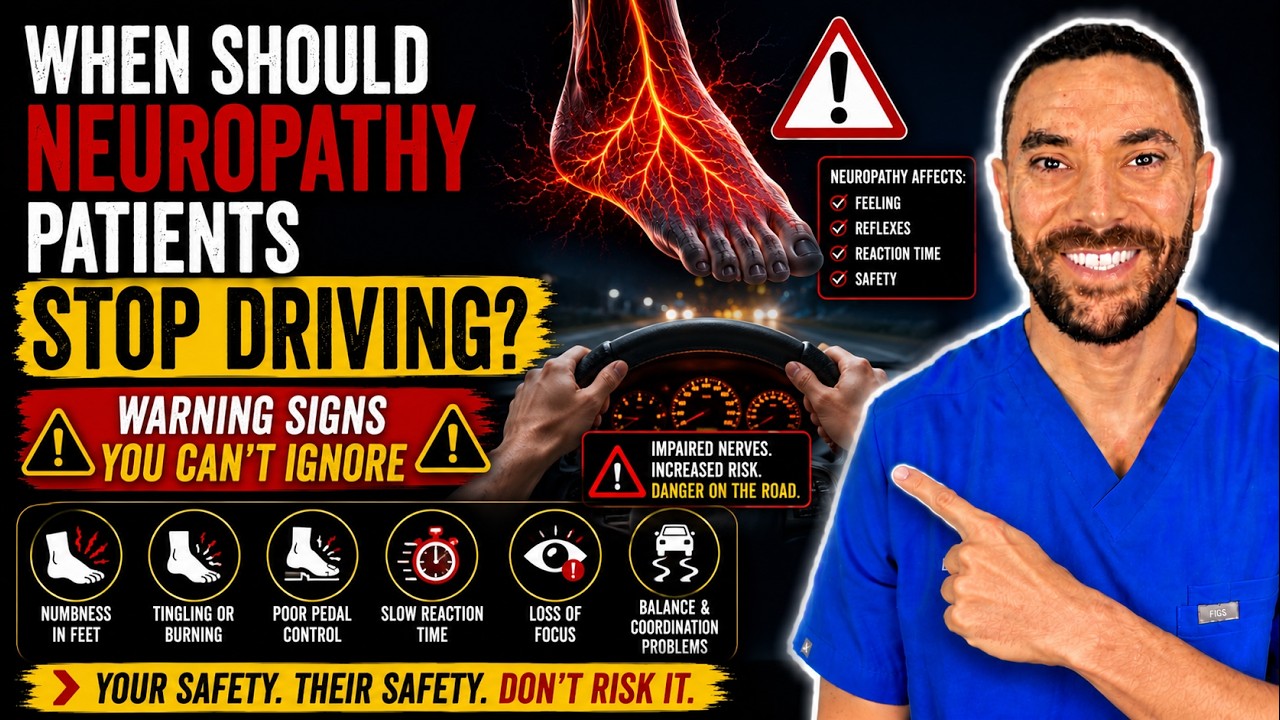
Short answer: most people with neuropathy do not have to stop driving. The time to stop, or at least get evaluated, is when you cannot reliably tell the gas from the brake with your feet, when your braking is late, or when your foot keeps slipping off the pedals. Dr. Mohamed Karim, D.C., tests for exactly this, and when the results say it is unsafe, he tells patients to let someone else drive.
What numb feet do to reaction time
Driving depends on a loop. The nerves in the soles of your feet report to the brain, and the brain sends instructions back down. In healthy nerves the fastest fibers carry those signals at roughly 270 miles an hour, which is why you can move your foot to the brake before you have consciously decided to.
Neuropathy slows that loop.
Dr. Karim sees the same delay in balance. A patient steps on a small rock, starts tipping left, and the correction from the brain arrives too late to stop the stumble. Behind the wheel, the same late signal means you press the brake a beat after you meant to. His comparison is simple: if you cannot tell carpet from tile through your feet at home, you may not be able to tell the brake pedal from the gas pedal in the car.
Warning signs to take seriously
- Delayed braking: you decide to stop and your foot takes a moment to follow.
- Stopping closer to the car ahead than you intended, because you thought you were braking and were not.
- Trouble sensing where the pedals are, or not knowing which one your foot is on.
- Your foot slipping off the pedals, so you keep looking down or guiding it back.
- Near misses.
- New anxiety about driving, or anxiety during every trip.
That last one is easy to dismiss as nerves in the other sense of the word. Dr. Karim does not dismiss it. Anxiety that shows up behind the wheel is often your brain noticing something your feet are no longer reporting.
Night driving is harder, and there is a reason
Many people with neuropathy rely on their eyes to make up for what their feet no longer tell them, for balance and for knowing where their feet are. At night the eyes have less to work with, and after a full day of compensating, people are simply more tired. If you notice that evening drives feel worse than morning ones, that fits the pattern.
How he decides whether you are safe to drive
During his evaluation he tests whether you can feel sharp touch, cold and heat on your feet, and whether you can tell which toe he is touching without looking. If several of those come back missing, he considers it a red flag and recommends someone else drive you, both for your safety and for everyone else on the road.
If you want a formal driving assessment, a certified driver rehabilitation specialist (CDRS) can test you on and off the road and, where it makes sense, set you up with hand controls that take your feet out of the equation. You can find one through the Association for Driver Rehabilitation Specialists at aded.net. Coverage varies, and many people pay for these evaluations out of pocket.
Does everyone with neuropathy eventually stop driving?
No. Dr. Karim is clear that every case is different. Neuropathy is a chronic condition that tends to get worse when it is left alone, and someone who reaches near-total nerve loss in their feet may have waited too long. Catch it earlier and work on the nerves, and in his experience many people keep their keys.
His advice for anyone who has noticed a change is short: say something. Do not hide it from your family or your doctor. The regret he hears most is from people who wish they had spoken up before the accident, not after.
Watch the full episode
Three takeaways
- Pay attention to late braking, slipping feet and near misses.
- Do not ignore a change in what you can feel.
- Independence and safety can go together when you get checked early.
Not sure how much feeling you have lost? Book a free consultation and ask for a sensation test, or read how neuropathy treatment in North Liberty works. Related: traveling with neuropathy.
This article summarizes a podcast episode and is general information, not medical or legal advice. Driving rules for medical conditions vary by state. See our medical disclaimer.
Free consultation
Talk to Dr. Karim about your symptoms
Iowa Wellness Center, 1395 Jordan St Unit C, North Liberty, IA. Patients come in from Iowa City, Coralville and Cedar Rapids.