
Told to live with neuropathy? Here is why Dr. Karim still sees room to improve
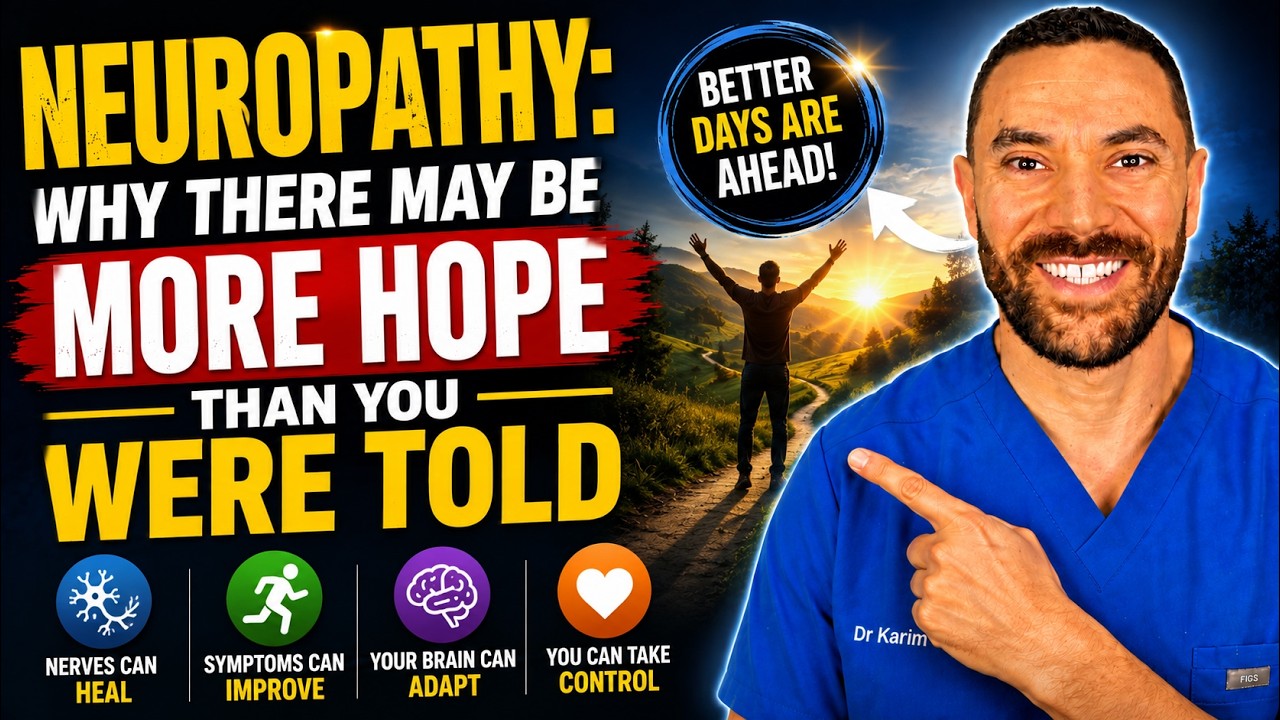
Short answer: being told “just live with it” is not the same as having no options. Nerves are slow to recover, so progress with neuropathy is measured in months, and it usually shows up as small wins like longer sleep or fewer bad days before it shows up as less pain. That is how Dr. Mohamed Karim, D.C., frames it for patients who walk into his North Liberty clinic after hearing “nothing can be done” from several providers.
Why nerves heal slower than a cut on your hand
Dr. Karim splits the body’s cells into simple and complex. Skin is simple. Cut it and it closes in a week or two. Brain cells and heart cells are complex, which is why recovery after a stroke or heart attack takes months of rehab rather than days.
Nerves sit in the complex group.
So when someone asks why their feet still tingle after three weeks of doing everything right, the answer is usually timing, not failure. “The changes that you see aren’t going to be drastic,” he says in the episode. “They’re going to be small changes over time.” For some people that means a few years of steady work. Others improve to a point, plateau, and then need ongoing care to hold what they gained. He is upfront that both outcomes happen.
The three things he works on
He calls it his “secret recipe,” though there is nothing secret about the list:
- Get the nerve firing again.
- Bring back circulation to the area, a process called angiogenesis (new small blood vessels forming).
- Bring down inflammation, both in the body overall and around the nerve itself.
Medications get a close look too. Some prescriptions can add to nerve damage, and he notes that patients on 20 or more medications are harder to manage than someone taking none. Any changes happen gradually, as symptoms improve, and some medications stay until the person is clearly feeling better.
What “better” actually looked like for one patient
One patient arrived convinced nothing would work. Multiple providers had told him so, and after years of hearing it, he believed it. What kept him looking was a small “what if.”
Months into the program he told Dr. Karim he felt hopeful for the first time in years. The reason was not a pain score. He had slept four hours in a row. Before that he could manage an hour or two before the burning and pressure forced him out of bed to walk it off.
Four hours sounds modest on paper. For someone who had not slept through a night in years, it was the first proof that the direction was right, and that tends to be what keeps people going through the slow part.
Where this approach came from
Dr. Karim’s first patient was his mother. She had fibromyalgia, which he counts as a type of neuropathy, and her flare-ups kept her in bed for five to seven days at a time. Looking for something beyond “good days and bad days,” he flew to Dallas every month to train with a group of neuropathy doctors and became board certified in neuropathy and chronic intractable pain.
Her flares dropped to one to three days. Better, but not done, so he went back to training and certified in functional neurology, which traces nerve pathways from the brain out to the fingertips and toes. By his account she has been free of flare-ups for about seven or eight years and now works on maintaining it. His rule for her, and for patients: feeling better is the point where you keep going, not the point where you stop.
Where neuropathy tends to come from
Dr. Karim uses a rough three-way split. About a third of cases trace back to type 2 diabetes. About a third come from other known conditions, such as fibromyalgia, restless leg syndrome and chemotherapy. The last third have no identified cause. That last group is often the most frustrating to live with, because “we don’t know why” easily turns into “nothing can be done.”
The first thing to change, before you call anyone
Asked what someone could start on today, he did not hesitate: diet. Most of the patients he sees eat too little protein and too many carbohydrates and poor-quality fats, much of it from food engineered to last months on a shelf. His direction is more protein, fewer carbs, better fats, and food closer to how it came out of the ground. Because he treats gut health as a driver of inflammation, this is also where he starts with patients who have type 2 diabetes alongside their neuropathy.
Mindset comes a close second. He is blunt about it: someone who has decided they are done tends to stop moving, and a sedentary body gives nerves less of what they need. People with a reason, grandkids, a trip, a job they want to keep, tend to put in the work.
What the first visits involve
This is not a 15-minute appointment. The testing alone runs an hour to an hour and a half, and the full evaluation is spread over two to three days, adding up to roughly three to four hours with Dr. Karim. He tests the brain, spinal cord and peripheral nerves, because a symptom in the feet can start somewhere else. Balance problems are a good example: often the brain is no longer reading signals from the feet quickly enough, so the correction that should stop a stumble arrives too late.
He also looks for things that quietly add to nerve damage, like an old lower back compression that has been pinching nerve flow for years.
If you do not live near North Liberty
Some patients work with him remotely. He can send a testing kit, review results over Zoom and set up an at-home protocol. He is honest that in-person care gives him a clearer picture and stronger treatments, so some people travel in for a few weeks, and some winter in Florida, Arizona or Texas and keep up their home routine while they are away.
Whether remote care would be enough for your situation is something he would rather work out in a conversation than promise up front.
Watch the full episode
Key points from the episode
- Nerves are complex cells, so recovery is slow and usually shows up as small changes first.
- The focus is nerve firing, circulation and inflammation, plus a review of medications.
- Diet is the first thing Dr. Karim asks people to change, starting with more protein.
- Some people keep improving for years, others plateau and maintain.
- The full evaluation takes three to four hours over two to three days.
Want to know where you stand? Read how neuropathy treatment in North Liberty works at the clinic, or book a free consultation by calling (319) 380-4380.
This article summarizes a podcast episode and is general information, not medical advice. Talk with your own doctor before changing medications. See our medical disclaimer.
Free consultation
Talk to Dr. Karim about your symptoms
Iowa Wellness Center, 1395 Jordan St Unit C, North Liberty, IA. Patients come in from Iowa City, Coralville and Cedar Rapids.